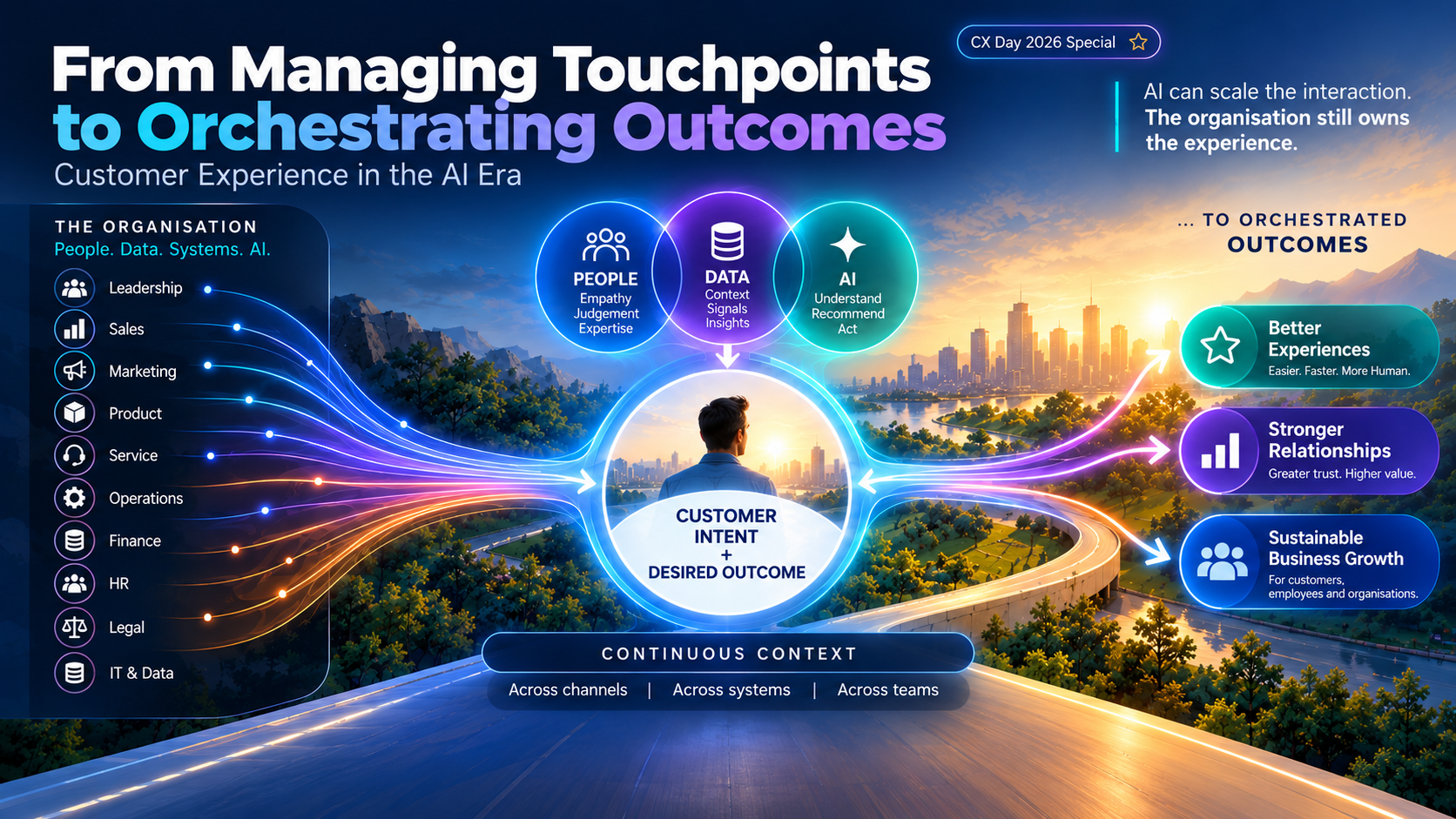
CloudDataAI Decode, third edition. A CX Day 2026 special, revisiting my 2023 article The Trifecta of Customer Delight. About 12 min read.
Three years later
Three years ago I wrote about something very ordinary: a grocery delivery that arrived with a few items missing.
I was away from home and had placed an urgent order with a local store I had trusted for years. The missing items were a small inconvenience. What made the incident stay with me was the delivery person, who seemed indifferent to the problem, and how quickly one poor interaction changed the way I felt about a business I had used for so long. What restored the relationship was just as simple. The store owner stepped in, listened, apologised and took responsibility.
That incident became the starting point for my 2023 article, The Trifecta of Customer Delight: Customer Service, Success, and Experience. My argument then was that customer experience is never owned by one team. Almost every function, from sales and product to finance and HR, shapes what the customer finally experiences. The problem was never really the missing grocery item. It was whether the organisation could understand what had happened and respond well.
I have been thinking about that incident again, because today I would draw the whole experience differently.
Replay the same order in 2026
Imagine the same order today. Before the delivery leaves the store, the system notices that what was packed does not match what I ordered. An AI agent checks the inventory, finds a substitute for one item, confirms another is unavailable and offers a refund for the third. I approve with a tap, the bill adjusts, the route updates, and the problem is solved before I ever experience it as a problem.
That is real progress, and there is a lot of hard work hidden behind it. The data has to be connected, the policies have to be clear, and someone has to decide what the agent is actually allowed to do.
Now change the scenario slightly. The agent applies the wrong refund policy. Or it keeps misunderstanding what I am asking. Or the delivery person is still indifferent at the door. Or I need a human and cannot find a way to reach one. Or, perhaps most familiar of all, the AI holds my entire order history, yet the person who finally joins the conversation asks me to explain everything from the beginning.
The technology has changed. The experience can still break.
So the question I keep coming back to is not "how much of CX can we automate?". It is "how do people, data and AI work together to deliver the outcome the customer actually came for?".
Technology has become the floor
In the original article I called technology the cornerstone of modern customer experience, and I wrote about CX platforms, analytics, prediction, chatbots and generative AI. I would put it differently today. Technology is increasingly becoming the floor rather than the differentiator.
Conversational interfaces, summarisation, recommendations and personalisation are becoming accessible to organisations at a scale that was not practical only a few years ago. That raises the baseline, but it does not raise the experience on its own. A better model does not repair a broken process. A friendlier interface does not fix fragmented customer data. A faster response is not the same as a correct resolution. And automating a poor decision simply lets it happen more efficiently.
What differentiates the experience now is what the organisation builds on top of the technology. Mostly, that comes down to whether it understands the customer's situation, can act on it, and is willing to own the result.
Customers experience outcomes, not touchpoints
For years we have designed CX around touchpoints: the website, the app, the store, email, social, the contact centre. Each one matters. But no customer wakes up thinking, "today I would like an excellent omnichannel experience". They are trying to get something done. Change a flight. Correct a payment. Find an order. Get a product working again.
That difference matters more in the AI era, because every touchpoint can perform well while the journey still fails. The website works, the chatbot answers, the call meets its service level, the case is recorded correctly in the CRM, and the customer still tells the same story three times. AI can even make this harder to see, because each automated step reports its own success.
This is why I think we are moving from managing touchpoints to orchestrating outcomes. I do not mean orchestration as a new buzzword or a software category. I mean that something now has to coordinate signals, context, AI, business rules, systems and people across the whole journey, and someone has to be accountable for whether the customer got what they came for.
The trifecta, three years on
In 2023 I described service, success and experience as the trifecta of customer delight. Service addressed the immediate need, success secured the long-term value, and experience shaped how the whole relationship felt. I still find that distinction useful, but AI is moving the lines between the three.
Service is becoming a system, where AI agents and people resolve things within policy and the measure is whether the resolution was right as much as how fast it came. Success is becoming more of a judgement call. AI can flag a renewal risk weeks before instinct would, but it still takes a person to make the commitment that keeps the relationship. And experience is becoming the discipline that owns the outcome and the seams in between, the places where work passes between teams, between channels and now between AI and people. That last role is what most of this Decode is about.
A view from Asia
From where I sit in India, the AI-era expectation is arriving faster than many global CX frameworks assume. Grocery delivery in ten minutes has become ordinary in large Indian cities, which makes my 2023 story feel almost quaint, and it raises the bar for recovery just as quickly: when the promise is measured in minutes, a missing item is felt in minutes too. Real-time payments through UPI have taught customers that money can move instantly, so a refund that takes five working days now feels like a choice rather than a constraint.
Service has also moved into the channels people already live in. Across much of Asia, customers expect to sort things out on WhatsApp rather than on a website, and in their own language rather than in English. India alone has 22 scheduled languages. That makes context and handoff harder. An AI agent that resolves an issue in Tamil and then hands over to a person who can see only an English summary has simply moved the seam somewhere else. For CX leaders in the region, the orchestration question is the same as anywhere else. The speed, the channels and the languages simply make it more urgent.
The CX Orchestration Loop
If I redrew my 2023 map today, I would put neither the customer service platform nor AI at the centre. I would put the customer's intent and the outcome they want. Around it runs what I call the CX Orchestration Loop: Signals, Context, Intelligence, Decision, Action and Learning. And around the whole loop sits something that can no longer be an afterthought: Trust & Governance.
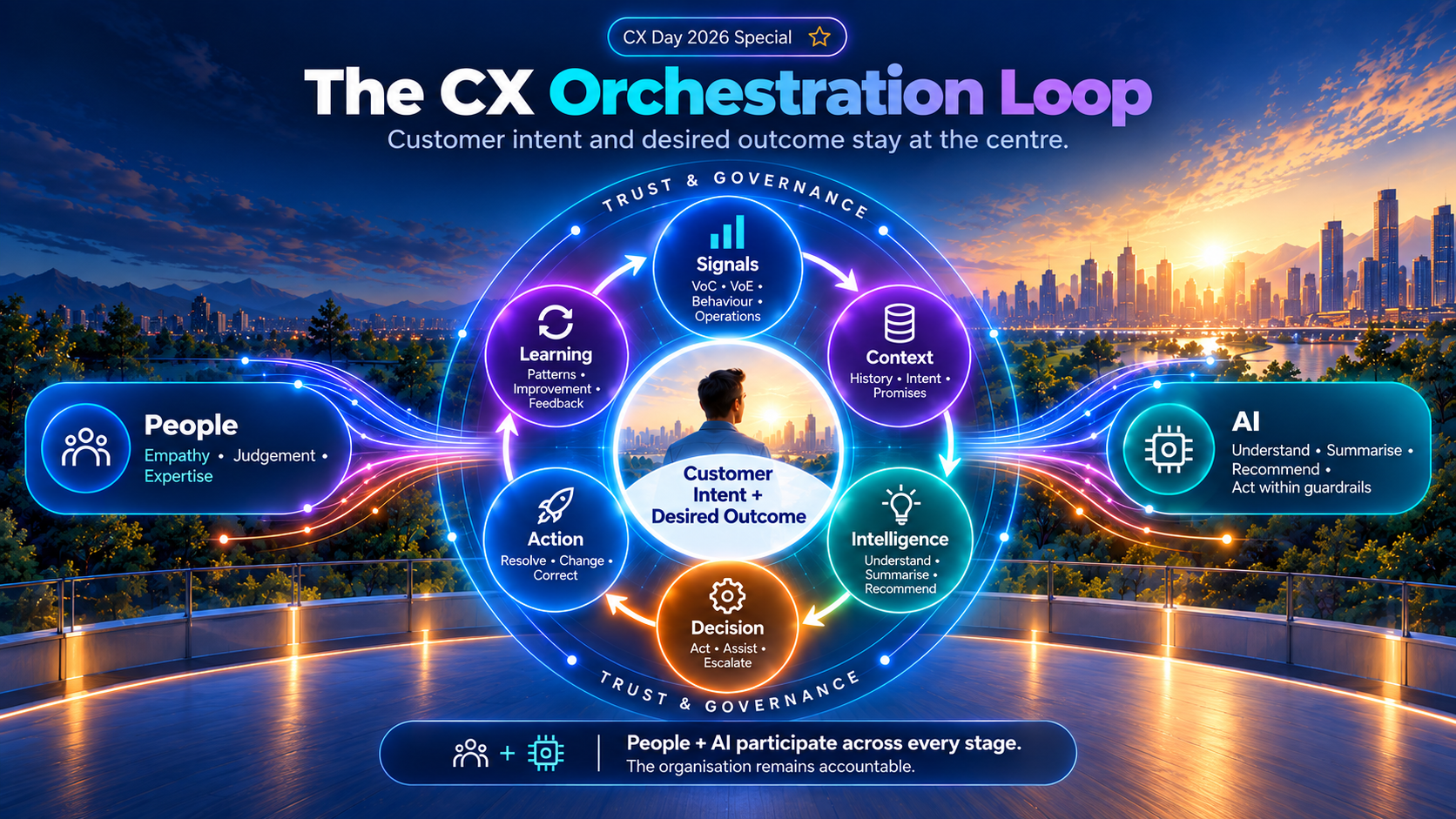
Signals: what is actually happening? My 2023 model listed Voice of Customer, Voice of Employee, social channels, website analytics, word of mouth, third-party sites, focus groups and surveys. Every one of them still matters, but the picture is far richer now. A customer may never fill in a survey and still tell us a great deal: by returning to the same page before abandoning, by calling three times about the same issue, by sounding frustrated on a call. Employees signal too, every time they override a process that does not work in reality. And operational systems often spot the failure before the customer says a word, which is exactly what makes the 2026 grocery replay possible. This matters because explicit feedback is shrinking: Qualtrics' 2026 study of more than 20,000 consumers found that only 29% give direct feedback after a bad experience (Qualtrics). Surveys are not irrelevant. They are simply no longer enough on their own. I would also add one new source: what our AI agents themselves said and did.
Context: what should we already know? Imagine calling about a failed transaction. The company knows your name, your account, the transaction, the earlier chatbot conversation and the fact that you already tried online. Yet the first thing you hear is, "Could you explain the problem?". The organisation had every piece of data it needed. What it had lost was the context. A customer record tells us who someone is. Context tells us what is happening now: what they are trying to do, what has already been tried, what we have promised, and what the next person or agent needs in order to continue rather than restart.
Intelligence: what does it mean? This is where AI brings real value. It can understand intent, summarise history, detect recurring friction, find the right knowledge and spot patterns across conversations no human team could ever review. But intelligence is not an outcome. Knowing a customer is frustrated does not solve their problem, and predicting churn does not retain anyone.
Decision: who should decide? Some decisions are simple. A delivery slot needs to move, the policy is clear and the action is easy to undo. Others involve a disputed charge, a vulnerable customer, a contract change or a claim, where emotion, uncertainty or real consequence are in play. So the question is no longer just "can AI do this?". It is "should AI act, should it assist a person, or should a person own this decision?".
Action: can we actually do something? This is where CX becomes real: the refund is issued, the delivery changes, the engineer is booked, the product defect reaches the team that can fix it. An assistant that can explain why a refund is due but cannot issue it has made the conversation better, but the customer is still waiting for their money.
Learning: did it work? The loop should not end when the case closes. Did the customer have to come back? Did the AI's recommendation hold, or did someone override it, and why? Is the same failure hitting other customers too? This is also where surveys find a valuable new role: asking what we cannot infer, and checking the models that now predict satisfaction from conversations.
From touch tiers to decision modes
In my original diagram I used Low Touch, High Touch and Personalised Touch. At the time this was largely an economic model. Human attention was expensive, so organisations decided how much of it each customer could receive. AI changes that equation, because personalised interactions can now be delivered at scale. So I would no longer design these modes around how valuable the customer is. I would design them around the nature of the moment.
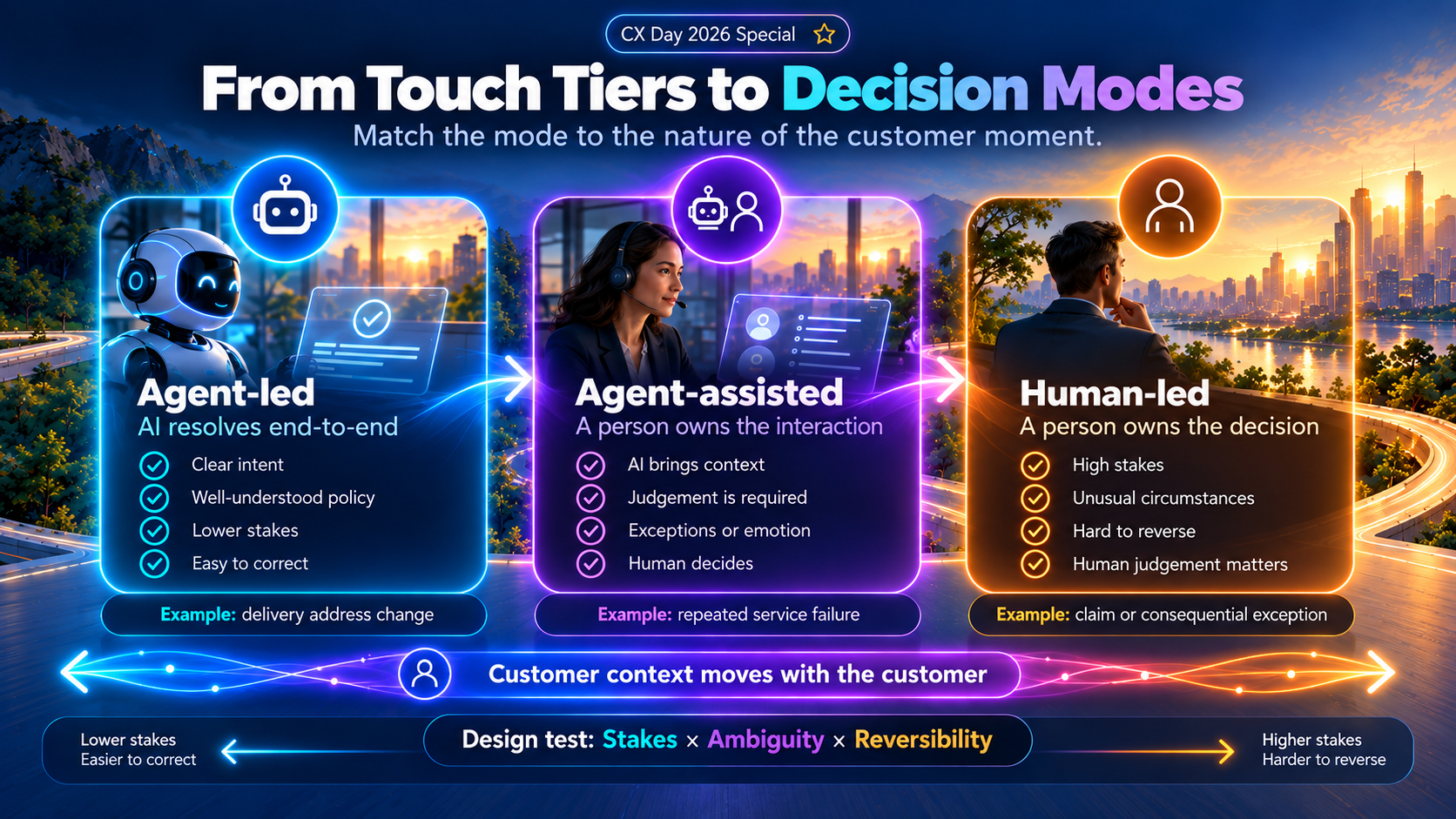
Agent-led. AI resolves the interaction end to end where the intent is clear, the policy is well understood, the stakes are low and a mistake can be put right. A change of delivery address is a good example.
Agent-assisted. A person owns the interaction, while AI brings the context, summarises the history, finds the knowledge, drafts the response and flags the risk. This is where judgement, exceptions or emotion come in, such as a service failure that has now happened twice.
Human-led. A person owns both the relationship and the decision. AI can still work underneath, assembling context and handling the administration, but it is not the decision-maker. This is right when stakes are high, circumstances are unusual, the consequences are hard to reverse, or human judgement is itself part of what the customer needs.
The design test becomes Stakes × Ambiguity × Reversibility. Reversibility is also useful when thinking about technology and platform decisions: the harder a decision is to undo, the more carefully we should make it. The same principle applies to customer moments. A refund can usually be corrected. A cancelled policy or a declined claim may be far harder to reverse. The same customer may move through all three modes in a single week, and they should never need to understand our operating model to do so.
The seam may matter more than the channel
One part of the experience deserves far more attention in the AI era: the handoff. From AI to employee, from service to sales, from the contact centre to operations, from one system to the next. We spend a great deal of effort designing what happens inside each interaction. Much of the customer's effort happens between them.
The chatbot authenticates the customer, and the contact centre asks them to authenticate again. The AI collects the details, and the employee cannot see them. The system identifies the problem, and the next team receives only a case number. Genesys' 2026 research found that 95% of consumers expect their information to carry across channels, yet 48% of organisations do not automatically pass information between virtual and human agents (Genesys). That is not really an AI problem. It is an orchestration problem, and putting AI on top of fragmented context can simply make the fragmentation more conversational.
It leads me to a simple principle.
If no one owns the handoff, the customer does.
When that happens, the customer becomes the integration layer. They carry the information, reconnect the process, find the next team and explain everything again, compensating for our fragmentation with their own time and patience. AI gives us a real opportunity to remove that burden, but only if the context moves with the customer.
Accountability does not transfer to the AI
AI is moving beyond answering questions to taking actions. That means we have to think not only about what an AI system can do, but what it is allowed to do, under which policy, on what evidence and with whose accountability.
A useful reminder came before today's more capable agents. In Moffatt v. Air Canada in 2024, a British Columbia tribunal held the airline liable for incorrect bereavement-fare information given by the chatbot on its website, and rejected the idea that the chatbot's answers could be treated separately from the rest of the airline's site (Business Law Today). The legal position will vary by jurisdiction and circumstance, but the broader CX lesson is straightforward. Customers experience the AI as part of the organisation. A wrong answer feels like the company's answer, a wrong action feels like the company's action, and a broken automated path with no way out feels like the company has chosen not to listen.
People matter more, but differently
None of this means every automated interaction needs a person behind it. It does mean we should resist the idea that AI-era CX is a contest between machines and employees. Gartner reported in February 2026 that 91% of customer service and support leaders surveyed were under executive pressure to implement AI. Yet nearly 80% of organisations planned to transition at least some agents into new roles, driven by the automation of routine tasks and the need for human expertise in complex or emotionally sensitive interactions, while 84% planned to add new skills to the agent role (Gartner).
That feels right to me. If AI handles more of the predictable work, people increasingly receive what is left: the exceptions, the difficult conversations, the judgement calls, the moments where policy and reality do not fit neatly together. If anything, that asks more of people, and of how well we support them.
It also takes me straight back to the store owner in my original story. What mattered was not just that he responded. He understood that the relationship mattered more than the transaction.
Trust is part of the experience
There is one more reason I would redraw my 2023 model. I would place Trust & Governance around the entire experience.
AI lets organisations infer more, personalise more, predict more and act more autonomously. That can make an experience wonderfully convenient. It can also make it uncomfortable very quickly. A recommendation feels useful when I understand why it is relevant to me, and intrusive when I have no idea how the company knew enough to make it. An agent that resolves something instantly feels effortless; the same agent making an important mistake, with no obvious way to correct it, can undo years of goodwill.
Customers are not asking organisations to know nothing about them. Qualtrics' 2026 research found that 64% of consumers want personalised experiences, but only 39% trust companies to use their data responsibly (Qualtrics). That gap is the real design brief. Customers want appropriate use, transparency and the confidence that mistakes can be put right.
So the governance work, from consent and data quality to deciding which actions an agent may take and who reviews them, can no longer sit behind CX as a set of controls. Customers feel it directly. This is also where CX leaders and data and AI leaders now need to work as one team, because an experience can only be as trustworthy as the data and governance underneath it.
Measure the outcome, not merely the automation
The measures I wrote about in 2023 (NPS, CSAT, CES, response time, resolution rate, retention and customer lifetime value) still have their place. AI does not make them obsolete. But we need to be careful about what the newer AI-era metrics actually tell us.
Take containment. It is useful operationally, because it tells us an interaction stayed within an automated channel. It does not tell us whether the customer's need was met. A customer who gives up inside a polite loop counts as contained, and so does one who calls back tomorrow. Speed has the same limitation: a fast wrong answer is still wrong, and low handling time can sit comfortably alongside high repeat contact.
So I would pair each operational measure with an outcome measure:
| Operational measure | Pair it with | What the pairing reveals |
|---|---|---|
| Containment | Verified resolution | Whether the need was met, or the customer simply gave up |
| Response time | End-to-end customer effort | Whether speed came at the cost of more work for the customer |
| Escalation rate | Handoff quality | Whether context travelled, or the customer had to start again |
| AI answer rate | Accuracy and human override rate | Whether the agent was right, not just fast |
| Case closure | Recontact | Whether "closed" actually meant solved |
There is a financial version of this discipline too, and it matters to every CFO approving an AI business case. Cost per contact falls almost automatically once AI arrives, so on its own it says very little. Cost per verified resolution says far more, because it counts only the contacts that actually solved something. And when AI does lower the cost to serve, the savings deserve a deliberate decision rather than a default one: how much returns to the bottom line, and how much is reinvested in the human moments that now carry the relationship.
And alongside NPS, CSAT and CES, I would ask a very simple question: did the customer accomplish what they came to do? It is an old question, and surprisingly few dashboards can answer it.
A CX Day test for leaders
CX Day falls on 6 October 2026, and CXPA's continuing theme feels particularly relevant this year: good CX delivers better outcomes for customers, employees and organisations. It is a useful test for AI-era CX too. Rather than celebrating how much AI we have introduced, I would ask five questions.
- What is the customer actually trying to accomplish? Start with the intent and the outcome before you identify the AI use case.
- Where should AI act, where should it assist, and where should a person decide? Base that on stakes, ambiguity and reversibility, not simply on what the technology can do.
- What arrives at the handoff? Follow one real journey from AI to human and see whether the customer's context travels with them, or whether the customer is still doing the integration.
- Who is accountable when the AI is wrong? Make policies, actions, escalation, correction and ownership explicit before autonomy is scaled.
- Are we measuring automation or improvement? Look beyond containment, volume and cost to verified resolution, effort, trust, recovery and the outcome the customer was seeking. And decide deliberately where the AI savings go.
None of these questions needs another CX platform to answer. Most of them need an afternoon and an honest walk through one real customer journey.
The Decode
When I look back at the model I drew in 2023, I do not think the fundamentals were wrong. The trifecta still holds: customer service, customer success and customer experience all still matter, and experience still spans the whole organisation. Empathy, the voice of the customer and the voice of the employee still matter. So do data, technology and leadership. My original conclusion was that technology and human understanding must work together to create meaningful customer relationships, and I would still say that.
What has changed is the machinery available to us. AI can now listen across enormous volumes of interaction, interpret natural language, connect information, recommend and increasingly act on its own. That lets organisations understand and respond to customers at a scale that was hard to imagine only a few years ago. It also lets them scale fragmented processes, poor policies and bad decisions much faster than before.
So the question for AI-era CX should not be how much of the customer journey we can automate. It should be how much better we can make that journey now that people, data and AI can work on it together.
Three years ago, a store owner's apology restored a relationship that one poor interaction had damaged. In 2026, better data, AI and automation may stop that situation from happening at all, and I would welcome that. But the owner's judgement, empathy and willingness to take responsibility were never inefficiencies for technology to remove. They were part of the experience. The opportunity now is to build systems good enough to make those recovery moments rare, and organisations wise enough to recognise when a human moment still matters.
AI can scale the interaction. The organisation still owns the experience.
Happy CX Day 2026.
An independent perspective by Prasana Kumar Parthasarathy. CloudDataAI Decode. Complex technology. Practical perspectives. Business reality. The field, not the feed.
Sources
- CXPA: CX Day 2026, Tuesday 6 October
- Qualtrics: 2026 Consumer Experience Trends, 20,000+ consumers in 14 countries
- Genesys: State of Customer Experience 2026 (July 2026)
- Gartner: 91% of customer service leaders under pressure to implement AI in 2026 (18 February 2026)
- Moffatt v. Air Canada, 2024 BCCRT 149 (BC Civil Resolution Tribunal), summary in Business Law Today
- The Trifecta of Customer Delight: Customer Service, Success, and Experience (2023)